Ballads and Blue Berets

On Wednesday 2nd September, Virgin Media TV hosted a debate on a number of topics. Chief among them was the ever-present question of whether Ireland needs to spend more on defence as our ruling class drives us further into the clutches of the NATO Alliance. Fionnán Sheahan, Ireland editor of the Irish Independent, was unreserved in his promotion of the ideas that Ireland is falling behind on its ‘duties’ as a participant in the European capitalist project, that it is embarrassing that the Irish state relies on Britain and France for national defence, and that, ultimately, Ireland needs to increase its defence spending substantially. Matt Carthy, Sinn Féin spokesperson for Justice, was the most outspoken in his opposition to some of Sheahan’s suggestions; however, he ultimately agreed with him that Ireland needs to invest in its defence capabilities.
This is unsurprising coming from Carthy. He wasn’t simply expressing his personal opinions, but also those of his party. Sinn Féin, while committed to neutrality and defending the Triple Lock, advocates for the expansion of the Defence Forces and increased spending in a number of “areas of greatest relevance and salience to Ireland” such as the navy.1 Their stances on this, in their defence, flow fairly logically from their long-standing position on neutrality. Carthy summed it up well when he said, in response to a question about the presence of a British navy vessel near Irish territorial waters for the purpose of security during the EU presidency:
“I think it’s embarrassing that we don’t have the capacity to police our own waters…there has only been one military that has been the sole cause of the deaths of Irish citizens over the past 50 years and it’s the same British Military that we are talking about here…we should have investment in our naval services and air force…that is very different from actually engaging in a formal framework with NATO powers”.2
For Sinn Féin and for many liberal anti-NATO nationalists like them, an integral part of the struggle to maintain the Irish state’s neutrality is building up the capacity of the Irish state to meet its defence needs (as understood within a nationalist-capitalist framework) by investing in areas like the navy and air force. The supposedly critical need is backed up by the repeated incidents of the Irish government having to rely on Ireland’s neighbours to enforce its ‘territorial integrity’. For both the pro-NATO and anti-NATO defence spending advocates, this is embarrassing. In the former’s case this is because in their eyes, Ireland is shirking from its duty as a nation that wants to ‘sit at the grown-ups’ table’, a duty that will lead us no doubt into regional and potentially intercontinental conflicts. In the latter’s case this is because reliance on France, and in particular Britain, undermines the sovereignty of the Irish State and thus its neutrality.
In the face of these arguments, much of the Irish left’s anti-war rhetoric seems quite weak. We speak of the need to maintain and defend Ireland’s tradition of neutrality; however, we come across as hypocritical when we reject the suggestion that the Irish state increase defence spending so that we aren’t reliant on our neighbours, which does logically infringe on the state’s neutrality. Images of RAF jets chasing off Russian planes and Royal Navy vessels scrambling to deter lurking submarines only reinforce this.34 We appeal to UN peacekeeping missions as sufficient exercising of the Irish state’s “duties to the international community” but have no answer when it is thrown back at us that policies like the Triple Lock inhibit such peacekeeping work. Increasingly too, people are looking out into an ever more violent and war-torn world, and are questioning the supposed unnecessary vulnerability of the Irish state. While they may not be won over to Sheahan’s vision of Ireland as a NATO-aligned airstrip for American bombers, many could well see the logic in Sinn Féin’s position of armed neutrality, particularly given that states with foreign policies of neutrality the world over tend to have large, well-funded militaries.
The left’s inability to put forward an alternative argument that does not collapse in the face of the realities of a militarising Europe is a reflection of the absence of the question of class in the equation, and the demands that then flow from it. Thus, any steadfastly socialist anti-militarism must be firmly based in stringent State oppositionism, and opposition to the so-called “international law” of the UN that has done nothing to prevent the ongoing genocide in Gaza.
The Irish State
The Irish (Free) State has for most of its existence been officially neutral; however, in reality it has been militarily reliant on external state forces for its defence, something that inevitably weakened such neutrality. This reliance in fact goes back to the very founding of the Irish State after the War of Independence. Michael Collins infamously used British 18-pounder artillery cannons to bombard the Four Courts, where Anti-Treaty IRA members had garrisoned themselves, officially starting the Civil War. The Pro-Treaty National Army would later receive eight more such pieces, as well as thousands of rifles and small arms from the British State. This material support from the British Empire contributed substantially to the National Army’s victory over the Anti-Treaty republicans, who at the beginning of the conflict had outnumbered the Free State forces.
While Fianna Fáil coming to power did help strengthen some aspects of the Irish state’s neutrality through attempts (however unsuccessful) to decouple the Irish economy from Britain, it has always come with a large asterisk attached. Being a dominion of the British Empire greatly limited Ireland’s ability to be neutral, as until 1933, Irish lawmakers had to swear an oath of allegiance to the British monarch, with Ireland only becoming fully legally separate from the Commonwealth in 1949. While this did not stop Ireland from remaining officially neutral during the Second World War, we were still functionally subordinate to the British state, even if a light touch was applied, and as such Ireland gave substantial preferential treatment to the Allied cause during the war. This, naturally, did not end with the conflict or with leaving the Commonwealth. In 1952, the Irish government negotiated a secret agreement with the British government essentially giving the RAF permission to intercept ‘hostile aircraft’ in Irish airspace.5 This has remained in place since.
The Irish state’s military reliance on the UK became a broader subordination to Europe when both states joined the European Economic Community in 1973. The Treaties of Nice and Lisbon saw the Irish state reaffirm its practical neutrality, as means to ensure that they passed their second referendums, both having failed in the first instance. However, since then, successive Irish governments have sought to erode this neutrality despite the promises made. One of the most significant developments in recent years was Ireland’s joining of PESCO, the justification being that it would enhance international security and allow the State to continue to contribute to UN peacekeeping.6 Additionally, this year, Ireland is holding the EU presidency, which is as much a chance to deepen these established defence links and increase the attacks on the Triple Lock policy as it was a chance for the Government to show off.
The United States of America has also made use of Ireland’s subordinate nature having long established Shannon Airport as a vital hub for military air shipment. Its use as a landing strip for transatlantic military flights dramatically increased leading up to and during the invasion of Iraq.7 While Ireland did not take part, the Irish state allowed the United States Air Force to use Shannon as a convenient refuelling site, through which military equipment and hundreds of thousands of American soldiers passed. Fianna Fáil would later begin talks looking to have Ireland take part in EU battlegroups. Clearly, from the Irish government’s point of view, while the people may perceive the state as neutral, they don’t consider it to be.
This is an emergent factor of the Irish state’s subordination to the US world-hegemon state and its allies, Britain and the EU. While Ireland has, for a substantial amount of time, been able to rely on the US and EU for defence, and thus reduce military spending, this reliance is beginning to strain as the US’s world hegemony wanes. Combine this with the US’s declining interest in defending its client states, and you have the situation the Irish State finds itself in. The US and EU are now demanding more from their subordinated states in terms of defence, and the Irish ruling class is attempting to respond. Simultaneously, you have, as represented to some degree by Sinn Féin’s perspective, an interest in the Irish state developing its own capacity for defence, independent of other states: an armed neutrality. This is a matter that is in flux, and often in contradiction, as the Irish government has shown that it is more interested in securing the necessary military equipment to supposedly strengthen Ireland’s defence capabilities and autonomy from France, something that will only deepen Ireland’s subordination to the EU.89
This all stands in fairly stark contradiction with the idea of Ireland’s neutrality as something that sees the state as equidistant from all world powers and political blocs. In reality, the Irish state is quite firmly aligned with Western imperialism. Nonetheless, structural, legal and cultural binds limit how much the Irish state can express this alignment, much to the Irish government and ruling class’s chagrin. This is why we are seeing these attacks on the Triple Lock, and why the government is so desperate to rid itself of this policy. This legal bind is, in some sense, easy to remove, however what remains is a large barrier both to the enacting of this erasure, and the following through afterwards: the significant cultural and political pressure from the Irish population which is still aligned to Irish neutrality, however diffuse and flawed the idea of it might be. As a result, the Irish ruling class is simultaneously waging an ideological struggle to justify the removal of the Triple Lock, and one of its strongest tools is the idea of the Irish peacekeeper.
Peacekeeping
While the Irish Government may not view Ireland as neutral, it still has to contend with this strong cultural and emotional commitment to Ireland’s neutrality amongst the general public. UN peacekeeping (and increasingly now EU-directed) missions offer themselves up as useful tools for the Government to work around, undermine and weaponise this sensibility. UN and EU peacekeeping in and of themselves are, in actual reality, rarely the outpouring of humanitarian concern that they are made out to be. Beyond the rampant sexual abuse and sex trafficking often taken part in and carried out by UN Peacekeepers, such missions often serve as transparent cover for otherwise imperialistic endeavours. The case of French intervention into Africa is only the most blatant example. It seems convenient that the countries to which French troops are sent coincide with nations France once ruled as colonies of its empire.10 It is a well-known fact now that France uses such deployments to achieve its own national security objectives, using the humanitarian concerns and directives of the UN missions as cover. France sees many of its former North African colonies as residing in its exclusive sphere of influence (which is a very similar view to that of Russia with regard to its immediate Eastern European neighbours), and deploys as it sees fit to defend its national political and economic interests; in 2013 French special forces were deployed to defend a Niger Uranium mine.11
Of course, France is not alone in its wielding of peacekeeping missions (both those UN-mandated and those not) in such self-interested ways. The EU itself has been taking part in such missions for over 20 years now. Similarly to France, the EU’s official justification for its military interventions primarily into Africa is that they are aimed at increasing stability in the respective countries, and defending specific populations from particular threats of violence.12 However, this too is just a cover for what are quite clearly efforts to establish itself as a military power in the region and defend the extraction of raw materials which the EU member states are reliant on in various ways.13 This is reflective of a longstanding colonial relationship that Europe has had with much of Africa, and it is therefore unsurprising that the countries most often involved in military missions are the former colonial rulers of the respective countries receiving the ‘humanitarian military assistance’. Before 2017, six out of the eleven active peacekeeping missions for which researchers had data, it was the former colonial power that provided the most troops.14
Activists and researchers have raised concerns over how the military interventions carried out by the EU and its member states are overseen by public, democratic bodies, and there seems to be little actual oversight in the decision-making of when to send military forces into non-European nations.15 The use of the European Peace Facility as the source of funding for such missions puts them outside the scrutiny of the European Parliament and thus out of the public eye, and allows the EU and its member states to engage in what are functionally colonial endeavours in Africa, freely. When the Irish government, then, pushes us towards deeper engagement with both ‘peacekeeping’ and defence missions of the EU and UN, and uses the excuse of said peacekeeping as a means to challenge and attempt to override the Triple Lock policy, it relies heavily on a massive ‘peacekeeping’ illusion that is widespread amongst the Irish population.
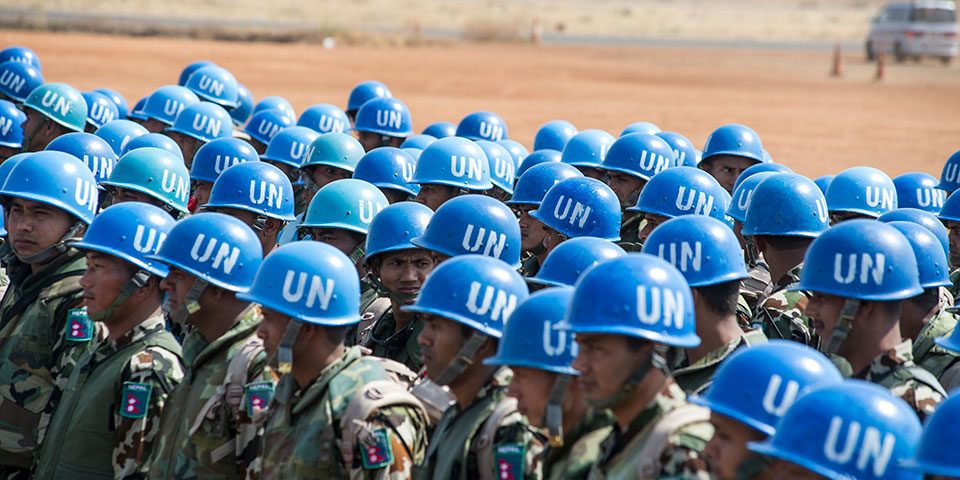
The Congo, the UN mission most celebrated in the Irish peacekeeping canon, shows us that the blue-beret, Security Council-sanctioned “genuine peacekeeping” is capable of just as much harm as the French adventures in its former colonies. In July 1960, the newly independent Congolese government asked the UN for help against Belgian troops and the secession of mineral-rich Katanga. Irish troops were deployed that summer, yet the UN refused to act against the secessionists, claiming neutrality in an “internal” matter. With the UN there, Lumumba could not call on African armies or the Soviet Union for the help the UN would not give. At the height of his power struggle with President Kasavubu, UN officials shut the capital’s airports and radio station, silencing Lumumba and grounding the troops he needed while his rivals could still be heard. Within a fortnight Mobutu seized power with Western backing. In January 1961 Lumumba was handed over to his enemies in Katanga and murdered on orders issued in Brussels, with UN forces standing aside. Only once he was dead and a Western-friendly government sat in Léopoldville did the UN turn its guns on Katanga. The force that stood aside while Lumumba was destroyed was now sent into battle; this was the campaign where the Irish soldiers were besieged at Jadotville. The Belgian sociologist Ludo De Witte, in his book The Assassination of Lumumba, puts the role of the peacekeepers plainly:
“the Blue Berets protected Katanga and played a decisive role in overthrowing the Congolese government.”16
It therefore is critically important that we not only challenge the government’s attempts to shatter any and all elements of what is left of our neutrality, but also break down the illusion of peacekeeping and Ireland’s role in it. We can’t fall into the narrative game of arbitrarily separating the Irish state’s current “genuine peacekeeping”17 from the future missions the Irish government wishes to involve us in. To accept that division is to give de facto backing to the deployments already underway.It’s quite clear that the government intends to wield popular support for the Irish Defence Forces’ peacekeeping endeavours to win public consent for dismantling the Triple Lock mechanism, and for facilitating Ireland’s deeper integration into European military structures.
Impassioned pleas to Ireland’s tradition of neutrality, which is often tied up with our history of peacekeeping in the mind of the average person, can only achieve so much when the very tradition itself is hijacked by the Government to justify the disintegration of our neutrality.18 As well as this, state loyalist parties that are supportive of Ireland’s status-quo neutrality still wish to use it to justify independent military build-up, which also has to be opposed. Therefore, a different strategy than one that simply defends a status quo neutrality on its own terms is required; one that has as its foundation a class analysis of both the state and the workers’ movement’s orientation towards it.
State oppositionism
The capitalist state is, by its very nature and dynamics, the state of the capitalist class. While the relationship between the state and the ruling class is complex and dynamic, fundamentally it is in the interest of the state to defend capital and the ruling class as a whole, not only because the capitalist class effectively rules the state, but because the state is reliant on the capitalist class to develop the means of production, something it cannot do itself outside of times of war.19 It thus follows, as most Marxists hold, that the working class cannot utilise the state for its own ultimate economic and political interests. It is simply structurally impossible to wield it that way.
Hand in hand with the principle of class independence, the recognition of the state in this way naturally calls for unrelenting opposition to it. If the state cannot be reformed and is intrinsically tied to the class it defends, then it is as much our enemy as the capitalist class itself is. From this, we can draw our positions on neutrality and the question of defence spending: absolute and unrelenting opposition to the militarisation of the state for any reason. This is not because we view peace as some abstract good, nor because we have some great love for the ‘moral integrity that the Irish state is granted by its “principled neutrality”, but because we recognise that the Irish state, as the state of the Irish capitalist class, is an instrument of our class’s oppression which must be resisted at all turns.
Arming the Irish state will not make Ireland safer, nor will it advance anything of worth for the working class. It would, instead, be as likely to see Irish men and women shipped off to fight on foreign soil to defend the economic interests of the EU and US, as anything else. It’s quite evident that the Irish government intends to weaponise the positive feelings which Irish people have towards our history of peacekeeping, to push for the removal of the Triple Lock, and for greater integration of the Irish military into the EU and NATO systems. We are already seeing this, with Micheál Martin saying that the requirement of a UN mandate for the deployment of Irish troops is a barrier to Ireland fulfilling its duties to the mission in Lebanon given the winding down of UNIFIL.20
Donnchadh Ó Laoghaire, Sinn Féin’s spokesperson for Foreign Affairs and Defence, said in response to the Micheál Martin’s comments on Lebanon that:
“Ireland should be pursuing every avenue to make the case for a new UN-led peacekeeping mission in Lebanon, or for an extended mandate for UNIFIL – even at this late stage – because UN-led missions are the gold standard when it comes to ensuring missions meet their objectives, and in ensuring that international law is upheld”.21
Even this is absolutely undesirable. The understandable focus on the Triple Lock, seemingly the only policy mechanism preventing the Irish government from throwing us head first into a wide variety of conflicts, has created this false dichotomy between undesirable, non-UN mandated ‘peacekeeping’ missions and desirable UN mandated ones. As we have already discussed, ‘peacekeeping’ missions are never what they seem. The humanitarian justification is only ever a cover for military operations to defend the political and economic interests of the countries involved.
To tackle this problem will require socialists not only to resist the attacks on Irish neutrality and the Triple Lock by the government, but also shatter the illusion of UN and EU peacekeeping altogether. As socialists, we should want the Irish state to have no part in such actions, and should resist them at every turn, no matter the official reasoning. It would also then follow that we need to challenge the very notion of the ‘peacekeeping mission’ as the desirable military operation. We should not stoop to using the language of ‘peacekeeping’, which validates the idea that there is ever a good reason for the Irish state to deploy its military. Our opposition to the State has to remain absolute, and this ultimately involves neither buying into nor furthering the illusion of ‘peacekeeping’ as a humanitarian good.
Conclusion
Ireland’s future is unclear. The Irish government seems set on dismantling any barrier to its goal of fully involving Ireland in the military operations of the imperialist West. The best the largest opposition party can muster in response is a call for Ireland to be involved in less international military operations. As we have discussed, the Irish State has functionally been aligned to the West from its very beginning, in one form or another, and this has been consistently in tension with both the cultural sense of neutrality common amongst the Irish population, and the legal mechanisms that concretise it. The Irish State and ruling class increasingly wish to bring the laws defining Irish military deployment more in line with the de facto political alignment of the state.
Therefore, the defence of the Triple Lock is correct insofar as it is a way to directly counter these efforts. Our task becomes, not defending Irish neutrality per se, but instead doing whatever we can to prevent the Irish state from removing the chains that bind it and prevent it from fully living out its political alignment. Defending the Triple Lock is thus not something that emerges out of a moral compunction for peace, or a belief in the sanctity of ‘true peacekeeping’, but from principled sabotage of the capitalist state’s interests i.e. state oppositionism.
It follows then, that in practical terms, this means taking up a position of outspoken and principled opposition to the Irish state’s involvement in peacekeeping, something that was unfortunately rejected at PBP’s last AGM. So long as we wish to use Ireland’s history of peacekeeping as a means to defend the Triple Lock policy, we will be fighting the establishment on its own terms, and as we have seen, they are as likely to wield the idea of peacekeeping against us as we are to use it against them. The illusion of UN peacekeeping as some politically neutral, moral good needs to be shattered if we are to advance a class-orientated socialist opposition to militarisation. Our world seems on the brink of another major global conflict, and so the stances we take now could shape the very future of our class. In the face of this and many other pressures, we need to remain strong and committed to the truth, and not allow the Irish state to weasel its way out of neutral binds we have placed on it.
If you want to get in contact with a submission or a response to the above review reach out at contact@horizonmag.ie
- Unknown, “Protecting Irish Neutrality”, Sinn Féin, (2025) https://sinnfein.ie/policies/ ↩︎
- Virgin Media News, “Defence & Neutrality: Is Ireland ‘Freeloading’ on Its Neighbours?,” September 1, 2026, https://www.youtube.com/watch?v=adfi-Z3LUHE. ↩︎
- Hutton, Brian, “Russian bombers in Irish airspace for second time in days”, Irish Times (2020) https://www.irishtimes.com/news/ireland/irish-news/russian-bombers-in-irish-airspace-for-second-time-in-days-1.4200213 ↩︎
- Gallagher, Conor, “British warship and ‘sub hunter’ helicopter deployed for EU meeting in Wicklow”, Irish Times (2026) https://www.irishtimes.com/ireland/2026/09/01/british-warship-and-sub-hunter-helicopter-deployed-ahead-of-eu-meeting-in-wicklow/ ↩︎
- Gallagher, Conor, “Secret Anglo-Irish air defence agreement dates back to the Cold War era” Irish Times (2023) https://www.irishtimes.com/ireland/2023/05/08/secret-anglo-irish-air-defence-agreement-dates-back-over-70-years/ ↩︎
- Unknown, “Dáil votes to join European defence organisation”, RTÉ, https://www.rte.ie/news/politics/2017/1207/925760-pesco/ ↩︎
- Unknown, “Military Use of Shannon Airport”, Shannon Watch, https://www.shannonwatch.org/Military ↩︎
- O’Connor, Niall, “Major French arms company to provide new armoured vehicles for Irish military”, (2026) https://www.thejournal.ie/french-company-knds-to-provide-new-armoured-vehicles-for-irish-military-as-negotiations-begin-6966577-Feb2026/ ↩︎
- O’Connor, Niall, “Government clears next hurdle in €300m+ plan to purchase military radar systems from France” (2026) https://www.thejournal.ie/dod-procurement-primary-radar-bit-by-bit-air-irish-defence-forces-7116729-Jul2026/ ↩︎
- Valeske, Josephine, “Under the Radar: Twenty years of EU Missions”, The Transnational Institute (2024) https://www.tni.org/en/publication/under-the-radar ↩︎
- Unknown, “France protects Niger uranium mine”, BBC (2013) https://www.bbc.com/news/world-africa-21318043 ↩︎
- Valeske, Josephine, “Under the Radar: Twenty years of EU Missions”, The Transnational Institute (2024) https://www.tni.org/en/publication/under-the-radar ↩︎
- Ibid ↩︎
- Ibid ↩︎
- Ibid ↩︎
- De Witte, Ludo, “The Assassination of Lumumba”, Verso (2001) ↩︎
- The distinction is drawn by People Before Profit representatives regularly. Paul Murphy for example in: Dáil Éireann debate, 27 January 2026, [Vol. 1079 No. 4], available at https://www.oireachtas.ie/en/debates/debate/dail/2026-01-27/3/. See also Richard Boyd Barrett in Pat Leahy, ‘Withdrawal from EU military co-operation will defend Irish neutrality, says Boyd Barrett’, Irish Times, 13 November 2024. ↩︎
- Gash, Julliette and Lenihan, Barry, “No Irish troops in Lebanon without UN mandate – Taoiseach”, RTÉ, (2026) https://www.rte.ie/news/2026/0902/1590101-irish-troops-lebanon/ ↩︎
- Macnair, Mike, “SUPPLEMENT: Imperialism and the state (Part I)”, Weekly Worker, (2022) https://weeklyworker.co.uk/worker/1387/supplement-imperialism-and-the-state-part-i/ ↩︎
- Gash, Julliette and Lenihan, Barry, “No Irish troops in Lebanon without UN mandate – Taoiseach”, RTÉ, (2026) https://www.rte.ie/news/2026/0902/1590101-irish-troops-lebanon/ ↩︎
- Ibid ↩︎